Quantum gravity
• A relatively promising theory (and which, in some aspects, uses the
same kind of concepts as those I defend here), is the one called “loop
quantum gravity” [1]. This theory however involves
(to my humble opinion) some “defects” of which
it is not obvious they would be avoidable.
• This theory “persists” in considering that quantized space-time a
priori exists ; it then adds to that some interactions (in the form
equivalent to some Feynman's
diagrams) by weighting some nodes of the graphs
; theses interactions influence space-time that contains them, but this
one can exist without them.
I think that on the contrary must be considered a theory where
space-time is only one of the properties following from interactions
(Feynman's diagrams) and nothing else : without interactions there is
no space-time.
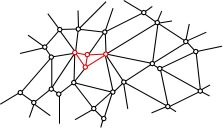
• When the loop quantum gravity considers (as
example) a photon that propagates in quantized space-time, it describes
this one as a local modification of the graphs representative of
space-time (what may be
visualized, in a very simplified way,
à l'aide the first of the above diagrams).
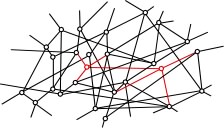
I think on the contrary that the graphs of space-time are much more
tangled (and this in a fundamental way, that is not only due to the
unavoidable simplification for the visualization) : what we consider as
“neighbour” at the macroscopic level (and thus what is at “small
distance” according to the space-time
metric) is not necessarily “neighbour” at the “microscopic” level, and
reciprocally.
Two points, some millions of light-years away according to the meaning
of our macroscopic metric, but connected by a
photon (or any massless particle), are at null distance in the meaning
of elementary interactions. The space itself proceeds from a multitude
of interactions a large number of which are between “very distant”
points (rather according to the second of the above diagrams) and which
“large distance” correlations
(including some E.P.R. type effects) cause the phenomena such as
inertia.
It does not look to me as indispensable
to add whatever else in order to bring in an inertial effect... and
thereby I am convinced that there is nothing to add : the only diagrams
to be considered would be those of interactions that happen in
space-time (Feynman's diagrams) and the gravitation would be only an
effect of their
multiple large distance correlations.
• Another approach, which falls into the same defects,
is the one evoked under the name of “euclidean quantum gravity” [2] :
in order to search for a limit structure describing space-time, one
must avoid to start from preexisting space-time polyhedrons.
• The interpretation may be moreover complicated by some a priori
connected to the usual concepts.
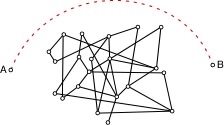
Let us consider as example the motion of a particle, from a point A up
to a point B, thus going in the neighbourhood of a zone with “high
density of interaction” (in the
following symbolic diagrams, the detail of the particle's interactions
during the motion is not specified) [3].
If one considers a “local” reasoning, one may conclude that a motion
which passes round the zone would be caused by an attraction : the
motion starts aside (without any previous intent to reach B), then the
attraction deviates it and causes it to
finally reach B. If
one considers a “global” reasoning, one may conclude in favour of a
kind of repulsion : among the ways which comes globally from A to B,
the more likely are those which don't cross the interaction zone and
are in such a manner “rejected” (in the same way as the magnetic
field lines are “rejected” by the supraconductors).
• Of course, in so far as it is not evident to find what topology to
associate with a so tangled hank, one can try to represent it (by a
kind of renormalization) by means of a “dual” theory, each graph of
which represents locally the global effect of large distance
correlations in the initial theory. It would thus be more or less to
the loop quantum gravity that would probably look like such a dual
theory. But in this case, if it is probable that this would allow a
best “connection” with our macroscopic description, it would not be on
the contrary representative of microscopic elementary diagrams.
It must be noticed elsewhere that, in despite of the analogy for “the
absence of gravitation”, the point of vue considered here seems to me
as devoid of direct relation with the kind of “dual” theory which has
been propound with extrapolation to the “border” of extra dimensions
[4] (but maybe that my incredulity is not independent of the doubts
that cord theories inspire to me).
__________________
References :
1. see as example : “Des atomes d'espace et de temps”, L.
Smolin, Pour la Science n° 316, february 2004.
2. see as example : “L'univers quantique auto-organisé”, J.
Ambjorn, J. Jurkiewicz et R. Loll, Pour la Science n° 371,
september 2008.
3. though the studied concepts are in a large part
different, some researches about communications in networks will
perhaps provide important ideas in this way ; see as example :
“Double clustering and graph
navigability”, O. Sandberg, <http://fr.arxiv.org/abs/0709.0511>,
september 2007.
4. see as example : “La gravité est-elle illusion ?”, J.
Maldacena, Pour la Science n° 339, january 2006.
Return to the beginning