DÉRIVÉES ET DIFFÉRENTIELLES - corrigé des exercices


A. EXERCICES DE BASE

I. Fonction de deux variables

1.    • La fonction est définie pour :   xy>0x \:y>0   et   y0y≥0  ;  c’est-à-dire :   x>0x>0   et   y>0y>0 .


2.    • En considérant  yy  constant, on obtient :  f(x,y)x=1x\frac{∂f\left(x, \:y\right)}{∂x}=\frac{1}{x} .

       • En considérant  xx  constant, on obtient :  f(x,y)y=1y+32y\frac{∂f\left(x, \:y\right)}{∂y}=\frac{1}{y}+\frac{3}{2}\sqrt{y} .

       • Pour  x=1x=1  et  y=2y=2,  on obtient en particulier :

              f(x,y)=ln(2)+22-12,52f\left(x, y\right)=\ln\left({2}\right)+2 \:\sqrt{2}-1≈2,52   ;   f(x,y)x=1\frac{∂f\left(x, \:y\right)}{∂x}=1   ;   f(x,y)y=12+322,62\frac{∂f\left(x, \:y\right)}{∂y}=\frac{1}{2}+\frac{3}{\sqrt{2}}≈2,62 .


II. Dérivées partielles et dérivée totale

       • Les dérivées partielles sont respectivement :  f(x,y)x=2xsin(y)\frac{∂f\left(x, \:y\right)}{∂x}=2 \:x \:\sin\left({y}\right)   et    f(x,y)y=x2cos(y)-1\frac{∂f\left(x, \:y\right)}{∂y}={x}^{2} \:\cos\left({y}\right)-1 .

       • On peut écrire :  df(x,y)=f(x,y)xdx+f(x,y)ydydf\left(x,y\right)=\frac{∂f\left(x,y\right)}{∂x} dx+\frac{∂f\left(x,y\right)}{∂y} dy   puis :  df(t)dt=df(x,y)dt=f(x,y)xdx(t)dt+f(x,y)ydy(t)dt\frac{df\left(t\right)}{dt}=\frac{df\left(x,y\right)}{dt}=\frac{∂f\left(x,y\right)}{∂x} \frac{dx\left(t\right)}{dt}+\frac{∂f\left(x,y\right)}{∂y} \frac{dy\left(t\right)}{dt} .

       • Compte tenu des dérivées partielles calculées précédemment, la dérivée “totale” a donc effectivement l’expression indiquée.


B. EXERCICE D'APPROFONDISSEMENT

III. Dérivées partielles et dérivée totale

1.    • La fonction est définie pour  xy.(y2-x)0x \:y .(y^2-x)≥0 .

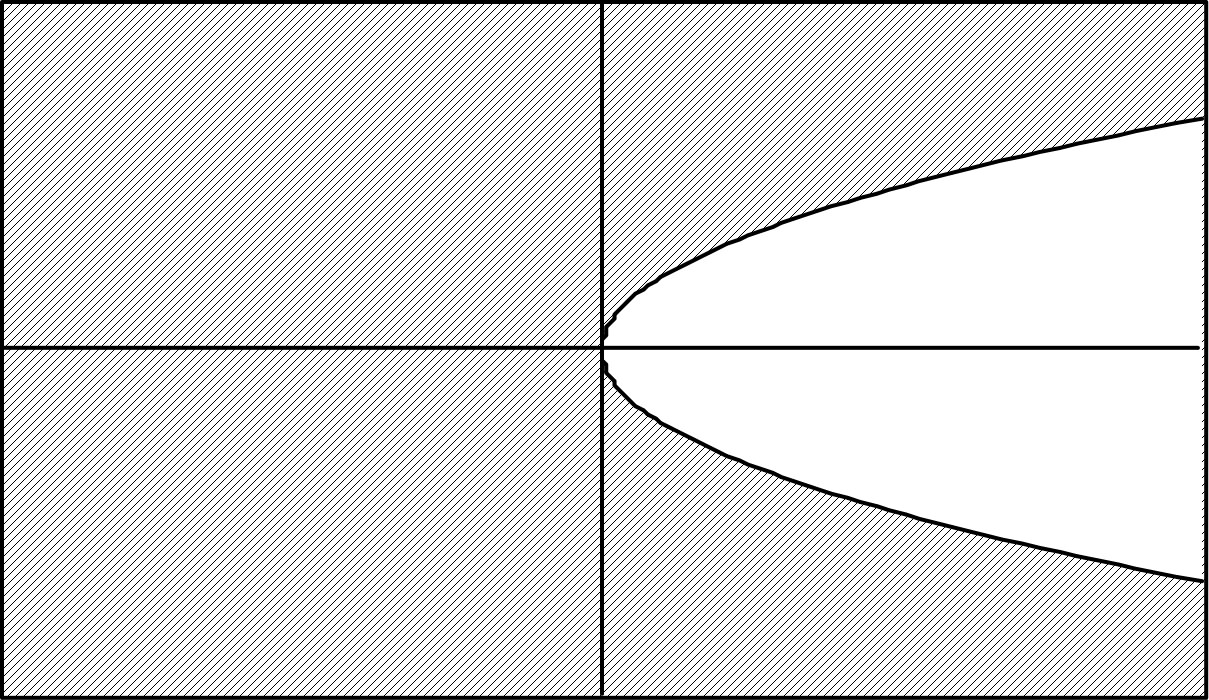
       • La relation  (y2-x)0(y^2-x)≥0  correspond à  xy2x≤y^2  (zone hachurée) :

derDiffer_cor_Im/derDiffer_cor_Im1.jpg

       ◊ remarque : il est plus rapide d’étudier  x=x(y)x=x(y)...

       • La relation  xy0x \:y≥0  correspond aux quarts de plan :  (x0x≥0  et  y0y≥0)  ou  (x0x≤0  et  y0y≤0).

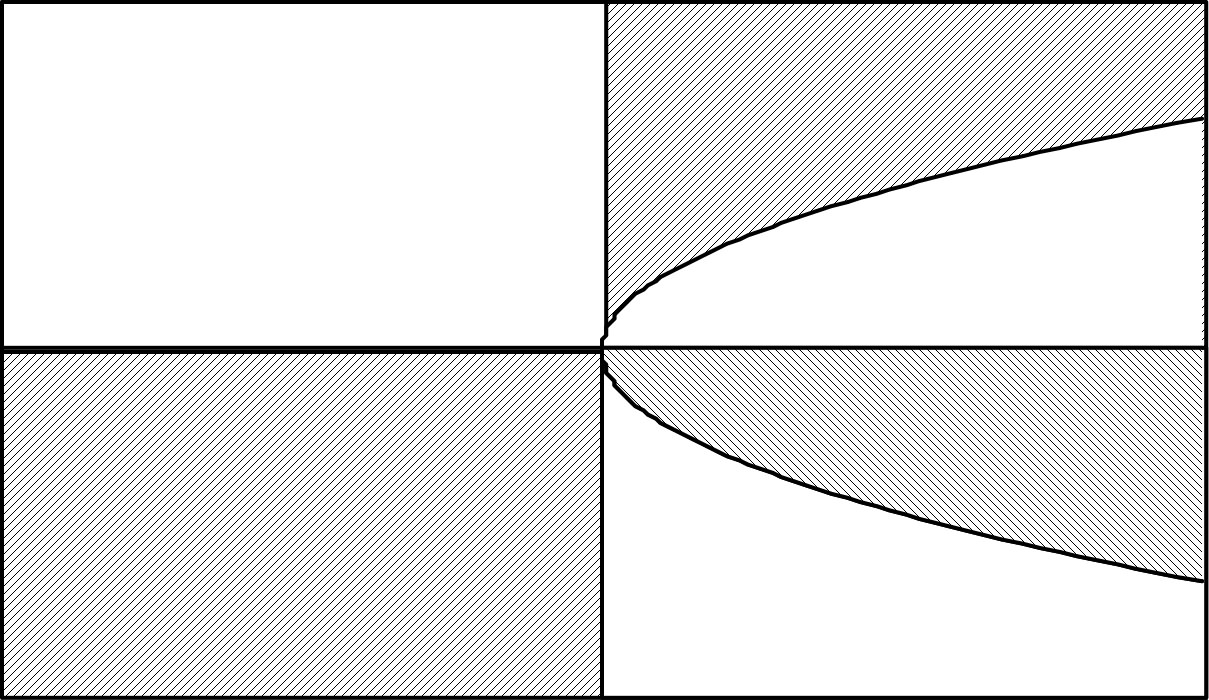
       • Le domaine de définition cherché correspond à :  (xy0x \:y≥0  et  xy2x≤y^2)  ou  (xy0x \:y≤0  et  xy2x≥y^2)  ;  donc par combinaison des deux conditions (zone hachurée) :
derDiffer_cor_Im/derDiffer_cor_Im2.jpg

       ◊ remarque : les limites sont acceptées.


2.    • On obtient :  f(x,y)x=y.(y2-2x)2xy.(y2-x)\frac{∂f(x, y)}{∂x}=\frac{y.\left(y^2-2 \:x\right)}{2 \:\sqrt{x \:y.\left(y^2-x\right)}}  ;  f(x,y)y=x.(3y2-x)2xy.(y2-x)\frac{∂f(x, y)}{∂y}=\frac{x.\left(3 \:y^2-x\right)}{2 \:\sqrt{x \:y.\left(y^2-x\right)}} .

       • Pour :  x=1x=1  et  y=2y=2 :  f(x,y)=62,45f(x,y)=\sqrt{6}≈2,45   ;   f(x,y)x=260,816\frac{∂f(x, y)}{∂x}=\frac{2}{\sqrt{6}}≈0,816   ;   f(x,y)y=11262,25\frac{∂f(x, y)}{∂y}=\frac{11}{2 \:\sqrt{6}}≈2,25 .


3.    • En substituant  y=y(x)=2x+1y=y(x)=2 x+1,  on obtient (il y a d’autres formulations possibles) :

              f(x)=f(x,y(x))=x.(2x+1)((2x+1)2-x))=x.(2x+1)(4x2+3x+1)f(x)=f\left(x, y(x)\right)=\sqrt{x .(2 \:x+1)\left((2 \:x+1)^2-x)\right)}=\sqrt{x .(2 \:x+1)(4 \:x^2+3 \:x+1)}\:  ;

              f(x,y)x=(2x+1)(4x2+2x+1)2x.(2x+1)(4x2+3x+1)\frac{∂f(x, y)}{∂x}=\frac{(2 \:x+1)(4 \:x^2+2 \:x+1)}{2 \:\sqrt{x.(2 \:x+1)(4 \:x^2+3 \:x+1)}}   ;   f(x,y)y=x.(12x2+11x+3)2x.(2x+1)(4x2+3x+1)\frac{∂f(x, y)}{∂y}=\frac{x.(12 \:x^2+11 \:x+3)}{2 \:\sqrt{x.(2 \:x+1)(4 x^2+3 \:x+1)}} .

       ◊ remarque : l’équation correspond à une courbe au moins partiellement dans le domaine de définition de la fonction (la partie pour  x0x≥0  et celle pour   x-12x≤-\frac{1}{2} ).

       • La dérivée totale peut s’écrire, après simplification :  df(x)dx=32x3+30x2+10x+12x.(2x+1)(4x2+3x+1)\frac{df(x)}{dx}=\frac{32 \:x^3+30 \:x^2+ 10 \:x+1}{2 \:\sqrt{x.(2 \:x+1)(4 \:x^2+3 \:x+1)}} .

       • Par comparaison, après regroupement au même dénominateur et simplifications, on peut vérifier qu’on obtient le même résultat pour :
              f(x,y)x+f(x,y)ydy(x)dx=(2x+1)(4x2+2x+1)+2x.(12x2+11x+3)2x.(2x+1)(4x2+3x+1)\frac{∂f(x, y)}{∂x}+\frac{∂f(x, y)}{∂y} \frac{dy(x)}{dx}=\frac{(2 \:x+1)(4 \:x^2+2 \:x+1)+2 \:x.(12 \:x^2+11 \:x+3)}{2 \:\sqrt{x.(2 \:x+1)(4 \:x^2+3 \:x+1)}} .